Joseph Giles Built Environment
Showroom craft and trade ordering, on one platform
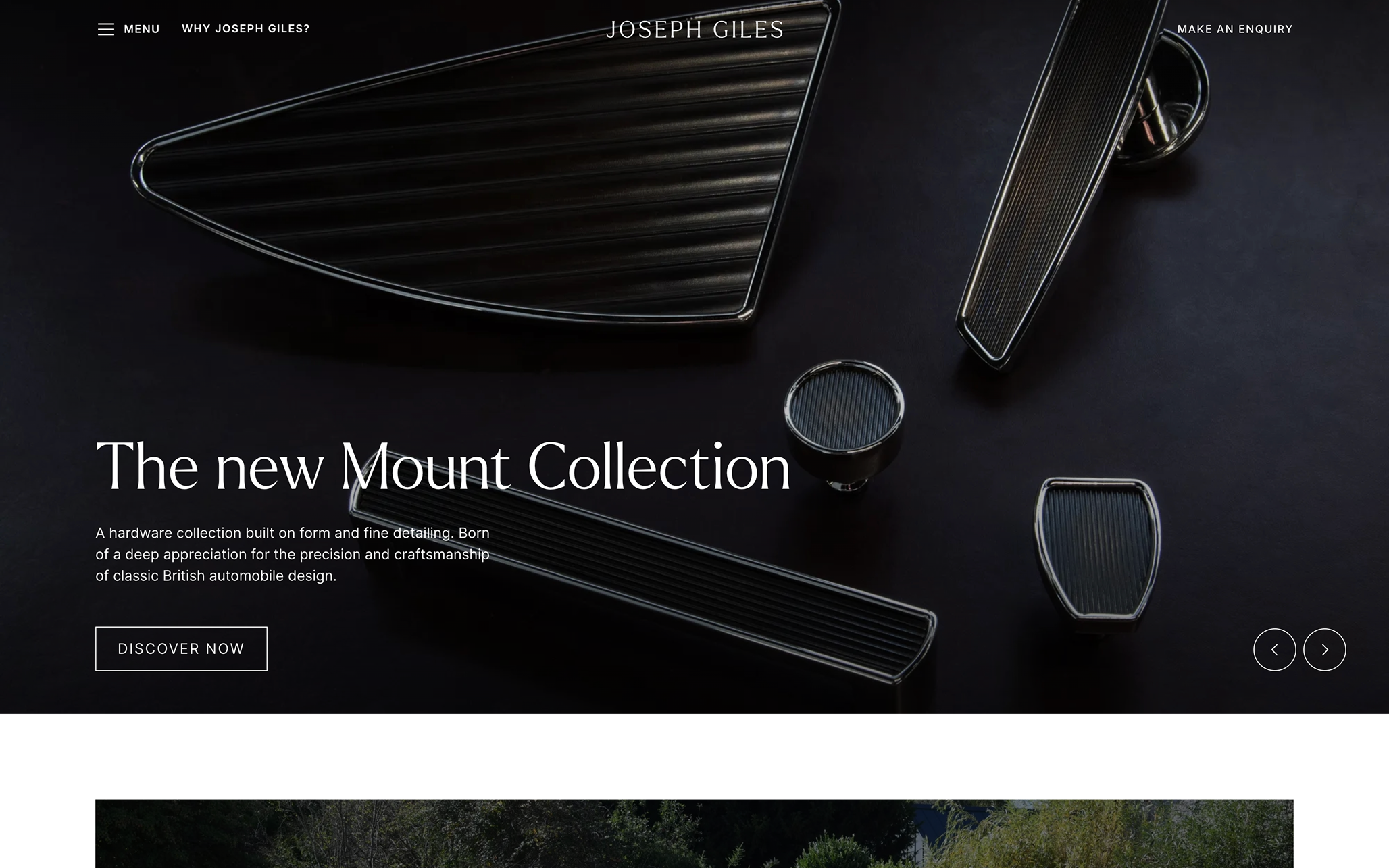
Joseph Giles designs and hand-finishes solid brass door, window and cabinet hardware in Britain, for private residences and hotels worldwide.
After a rebrand, Joseph Giles needed a site that could do two jobs: show the work in a way that inspires, and take orders from the trade. Its product data lived in an ERP, its photography in Bynder and its marketing content in Storyblok. We were commissioned to define the architecture, design the site and build a headless platform that joins the three up.
One record for every product
A middleware layer on AWS gathers product, image and content data into one store, so every page reads from a single source.
The catalogue’s data came from three systems. Asking the ERP, Bynder and Storyblok for it at page load would have tied every page to the slowest of them. We built a middleware layer on AWS instead: Lambda functions pull from each system into DynamoDB, and the site reads one GraphQL API. The layer also keeps the site independent of any one system: if the ERP changes, only the integration has to. It runs in Joseph Giles’ own AWS account.
The ERP could not reliably hold categories, URL slugs or the link between a product and its images, so the middleware has its own admin for them. Product URLs are generated from their categories, so thousands of products across two markets need no hand-kept paths.
Two markets, one catalogue
UK and US customers browse the same catalogue, with market-specific fields where the ranges differ.
Most of the range sells in both markets, so we kept one catalogue with field-based translations and market overrides. The US store launched from the same data, with no second database to build or maintain. Algolia indexes about 3,500 products for search and filtering by category and finish. In load testing the API held steady at up to 20,000 visits a minute.
Trade accounts carried over
Trade customers kept their accounts and their pricing on the new site, and ordering opens only where both the buyer and the product qualify.
Every product page builds a configuration code as the visitor picks a variant and finish, and anyone can send it as an enquiry. Logged-in trade customers see their own price, fetched live from the ERP under their company’s terms. We migrated the ERP’s trade accounts into Amazon Cognito, so customers kept their accounts and their trade pricing from day one.
In 2026 we added Self-Serve Quote. Trade customers build an order on the site and it arrives in the ERP as a quote. Add to Order appears only when both the customer and the product meet Joseph Giles’ criteria.
Photography at a lighter weight
Sized image derivatives from Bynder, served through CloudFront, cut the homepage’s mobile images from 1.8MB to 550KB.
Joseph Giles sells on close-up photography of hand-finished brass. Bynder produces sized derivatives of each image and CloudFront serves them, so the homepage’s images are 69% lighter on mobile and almost a third lighter on desktop, with no loss of detail in the photography.
Our Story is one of Joseph Giles’ most visited pages, so we designed a bespoke animation for it. Everywhere else, motion stays quiet and the photography leads.
Studio, a second voice
Studio launched in autumn 2026 as a more editorial sub-brand, on the same platform and still recognisably Joseph Giles.
Studio needed its own character without becoming a separate site. It sets Inter in white-led layouts with light-grey section breaks and restrained brass accents, and is built on the main site’s design framework and much of its front-end code. Its pages are edited in Storyblok like the rest. Because it reuses the platform, Studio launched without a second site or a second build. On the homepage, Studio joins the banner carousel, and the three “Why Joseph Giles” brand pillars move into their own navigation panel so they stay in reach.
Impact
Joseph Giles now serves trade customers in two markets from one catalogue that its own team runs, and the platform has already taken on a second brand.
Trade customers in the UK and US log in to their own pricing and send orders straight to the ERP as quotes. Visitors browse deep, seven pages each on average, and the homepage reaches a phone at under a third of its former image weight. Day to day, Joseph Giles’ team runs the catalogue itself: new finishes, categories and pages go online without a developer.
The platform was built to outlast its parts. A legacy site that had sprawled into tens of thousands of URLs is now a clean catalogue, with every product address generated from its category. The systems behind it can change without the site changing, and a new brand can join it without a second site. We have worked with Joseph Giles since 2023, and the platform, live since spring 2025, is still growing.
Related case studies
View all projects