


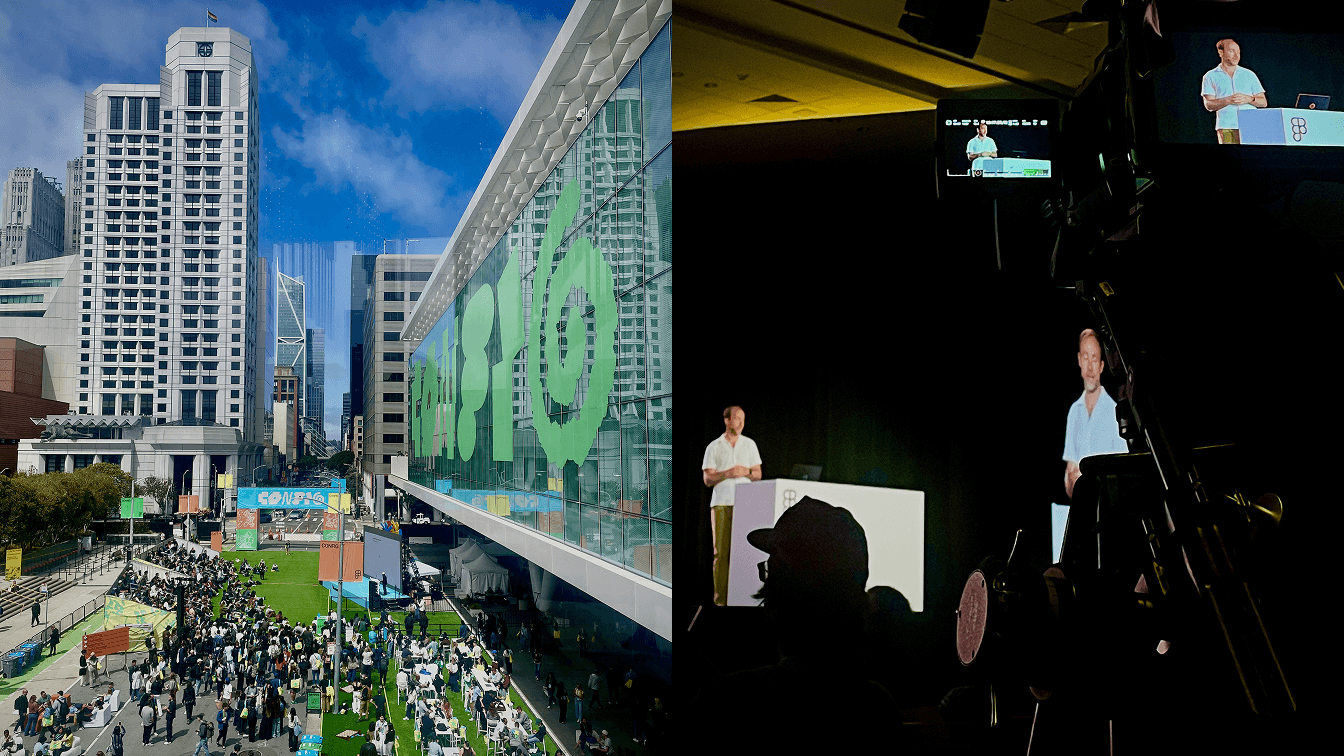






Andrew Warden opened the Spotlight Stage at Old Billingsgate with the number that framed the day and ultimately the opportunity for brands.
“In a Semrush sample of 1,094 topic categories, 85% had no brand that owned the conversation.”
He called it AI visibility’s dot-com moment.
Warden ran marketing at Semrush and is now Adobe’s global vice president of marketing. A disclosure: Semrush is a client. We built its AI Visibility Index, the platform that tracks how brands show up in AI answers, so we’ve watched this market form from close range. I spent the day on that stage with more than 1,000 marketers, loved the energy in the room, and left one of the most informative conferences I’ve attended in years.
Search has a new name.
Adobe agreed to buy Semrush for $1.9 billion last November and closed in April. In June, it launched Adobe Brand Visibility, sold as a way to make a brand “visible, trusted and chosen across AI surfaces”. Three disciplines sit under the name: search engine optimisation (SEO), generative engine optimisation (GEO) for AI answers, and agentic search optimisation (ASO) for the agents that shortlist on a buyer’s behalf.
“Visibility is no longer something you achieve through isolated tactics,” Warden said at Adobe Summit in April. “It must be engineered through a repeatable operating model.”
If everyone has the same tools, how do you win?
Your competitors can buy Brand Visibility, Semrush and every AI writing tool just as easily as you can. The dashboards show everyone the same prompts, gaps and recommended fixes, and Adobe can deploy those fixes automatically. Optimise a whole category against the same data and the answers start to look alike. The WPP-led panel had a name for where that ends: lazy, copycat marketing.
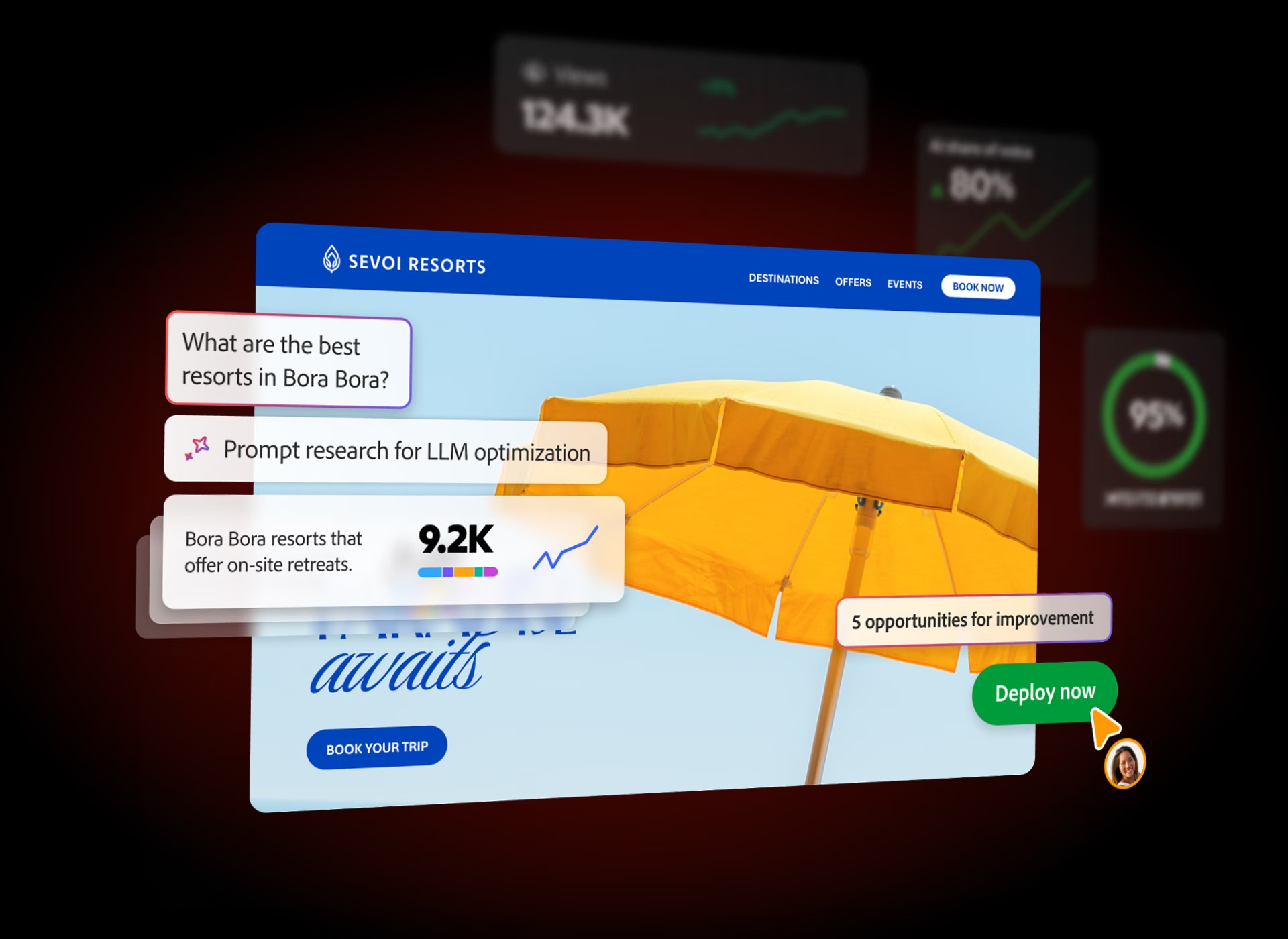
So the tools are the new baseline, and what wins is what they can’t produce for you. Semrush defines brand visibility as being “discoverable, authoritatively represented, and commercially actionable”. Software helps with the first. The other two come down to choices only a brand can make: the two or three topics it has a right to lead, what it claims about them, and the evidence it holds that nobody else does. Motorway’s Cassie Hall said its National Car Index, built on its own data, is how it proves to machines that it can be trusted. Marissa Dacay, who leads enterprise marketing at Adobe, was blunter: there’s no luxury of time, so start with what your brand stands for.
The same logic runs through the wider economy. As AI makes products and content cheaper to copy, value moves to what stays hard to copy: the chips at one end and the customer at the other. Elon Musk summed up the first last December, replying to an investor who’d bought into Alphabet: “Hardware is the end game.” Peter Thiel made the case for the second in 2014: “Superior sales and distribution by itself can create a monopoly, even with no product differentiation.” Few of our clients will make chips. All of them compete for the customer, and brand is how you hold one when a machine makes the introductions.
Where the proof lives
Your site is the holder of the claim, but critically the proof sits elsewhere, some interesting data shared at the event:
- Kevin Indig showed Aleyda Solis’s August study of 15 brands on three AI platforms: their own sites earned 13% to 35% of citations, depending on engine and industry.
- Seer Interactive and Trustpilot looked at 804,491 AI responses across 1,926 brands, and review sites’ share of citations rose from 1.5% at awareness to 24% at the point of intent, an association rather than a proven cause.
- Hall said 85% of Motorway’s citations come from off its site.
So owning a topic takes both halves: the claim, stated in full on your site with evidence a model can check (GrowthX’s Marcel Santilli called the website the truth layer), and the outside proof that makes the model believe it.
How we did it for Cool Earth
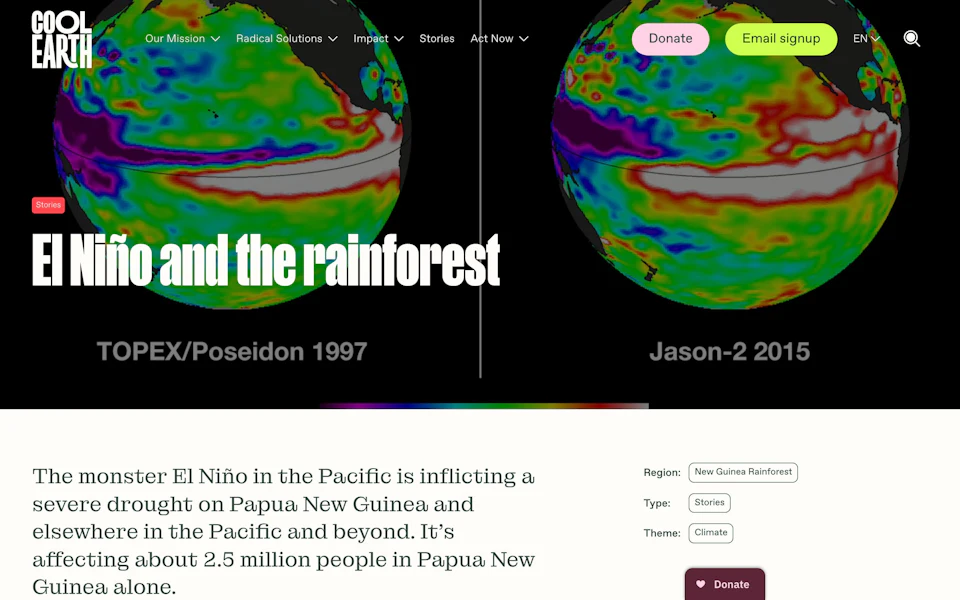
We’ve worked with Cool Earth, the rainforest charity, since 2024. Its website is its primary channel for donations, and when we rebuilt it, the archive was the problem. The content led with how Cool Earth gives, by funding indigenous communities directly. That’s the novel part, but people ready to donate were asking about the problem: climate change, El Niño, which charity to back.
We found a set of core themes in the archive and are rebuilding around them, alongside hub pages for each geographic region that Cool Earth operates in. These new pages coupled with new article frameworks are all structured for how search engines and AI assistants retrieve information. Weaker pages are being consolidated to create stronger evergreen content, and our Optimise team continues to support the Cool Earth team. The work is already bearing fruit: ask an AI about the impact of El Niño on the rainforest, and Cool Earth is the source. In the year after relaunch, raw traffic fell while donations and online income grew by more than a fifth.
What to do now
These are the most important things to be considering right now, given most of those 1,094 topics are still open:
- Pick the two or three topics you have a right to lead, and only those.
- Plan the claim and the proof together instead of splitting them between web, PR and the reviews team.
- Publish evidence only you hold (data, results, first-hand expertise) and ensure that you have external mentions that back it up.
- Track your position against the same competitors every month, improving visibility can happen in shorter cycles than SEO.
Use the tools; Semrush has democratised the software, and your competitors are likely already researching.
If you’re at a loss or want to get a leg up, our AI visibility audit is a good starting point for marketing teams.

